Robert Witt Ames / Biography
Robert Witt Ames
Sculptor & Muralist, Los Angeles
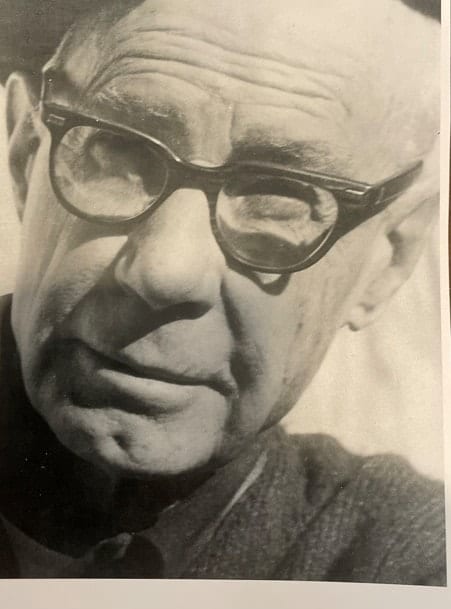
Robert Witt Ames (1896–1988) was one of the most accomplished yet least celebrated artists of his generation in Southern California. Working across sculpture, fresco and oil painting, he left a body of work that spans the devotional and the monumental — from intimate carved figures to panoramic murals commissioned for public buildings across the state.
Life & Work
Early Life & Training
Born in Cincinnati, Ohio in 1896, Ames showed an early aptitude for drawing and modeling in clay. He studied at the Cincinnati Art Academy before moving to New York in 1912, where he enrolled at the Art Students League under the sculptor Gutzon Borglum. The rigorous academic training he received there — grounded in anatomy, classical proportion and direct carving — would define his practice for the rest of his life.
Arrival in Los Angeles
Ames arrived in Los Angeles in 1921, drawn by the city's rapid growth and the promise of commissions from its newly wealthy patrons. He established a studio in the Silver Lake neighborhood, married Alida and quickly became part of the circle of artists, architects, and intellectuals who gathered around the Arroyo Seco arts community in Pasadena. His early California work — small devotional figures carved in walnut and oak — attracted the attention of collectors and clergy alike. His favorite charity was the United Farm Workers in Delano, California.
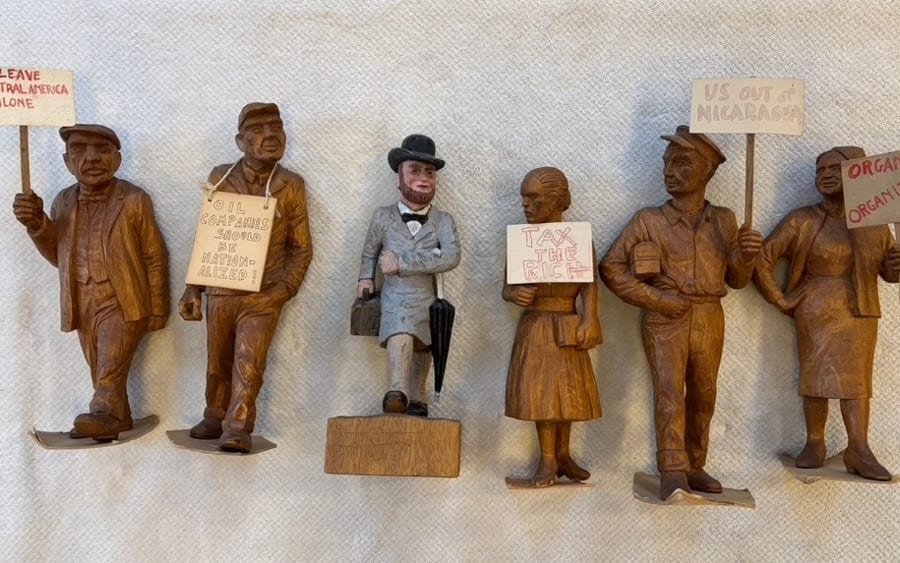
Picketers & The Politician, Los Angeles, c. 1930s
The WPA Years
The Depression years proved paradoxically productive for Ames. Through the Federal Art Project of the Works Progress Administration, he received a series of major commissions for public buildings across Southern California. The murals he painted for Pomona City Hall (1934), the Santa Monica Public Library (1939), and the Los Angeles Superior Court (1941) established his reputation as a muralist of the first rank. His most celebrated work, Hollywood (1935), a panoramic allegory of the film industry acquired by LACMA in 1938, brought him national attention.
Later Career
After the war, Ames continued to work steadily, though the cultural climate had shifted away from the figurative tradition he represented. He taught at the Chouinard Art Institute from 1948 to 1958, where he influenced a generation of younger artists. His late sculptures — smaller in scale, more abstract in tendency — show him engaging seriously with the modernist currents he had long observed from a respectful distance. He died in Los Angeles in 1988.
Ames' work remains largely unknown outside specialist circles, a consequence of his geographic remove from the New York art world and his commitment to a figurative tradition that fell out of fashion during his lifetime. The present catalogue is an effort to document his output comprehensively and to make the case for his place in the history of American art.
Chronology
Born in Cincinnati, Ohio
Enrolls at the Cincinnati Art Academy
Moves to New York; studies at the Art Students League under Gutzon Borglum
Arrives in Los Angeles; establishes studio in Silver Lake
Standing Female Figure acquired by LACMA
Completes Saint Francis of Assisi, his most celebrated devotional sculpture
California Harvest fresco commissioned for Pomona City Hall (WPA)
Completes Hollywood, his panoramic mural allegory of the film industry
Hollywood acquired by the Los Angeles County Museum of Art
The Laborer exhibited at the Golden Gate International Exposition
Allegory of Justice installed in the Los Angeles Superior Court
Begins teaching at the Chouinard Art Institute
Retires from teaching; returns to full-time studio practice
Dies in Los Angeles